

.svg)
Change Your Minimum Stay. Make More Money.
Change Your Minimum Stay.
Make More Money.
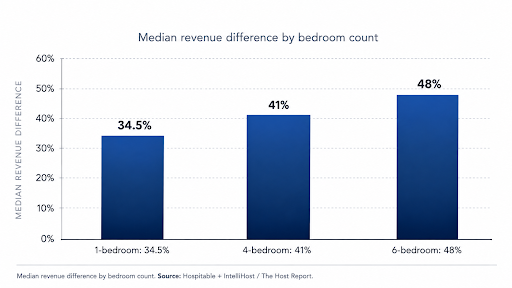
A 4-night minimum generated 34.5% more annual revenue than a 1-night minimum on comparable 1-bedroom listings.
That finding comes from The New Rules of STR Performance, a joint report by Hospitable and IntelliHost that analyzed 4.1M+ active listings and 460,000+ reservations across the 12 months ending March 2026.
Median annual revenue shifted from $23,822 to $32,060 just by changing the required stay length.
The gap widens on larger homes. Four-bedroom listings with a 4-night minimum earned 41% more than comparable 4-bedroom listings set to 1 night. Six-bedroom listings saw a 48% difference.
Where Your Calendar Gives Away Revenue
Shorter stays are useful on weaker date ranges. They can fill orphan gaps, recover revenue close to arrival, and keep the calendar moving on nights that would otherwise sit empty. But if the same loose rule stays active on peak weekends, holidays, and event dates, you are giving away strong dates to shorter stays.
A holiday weekend in October might have guests willing to pay $400 a night for a 3 or 4-night stay in a fall foliage market, a college football town, or a lake destination at peak season. If your calendar is set to a 1-night minimum, a guest books Friday night for $400, checks out Saturday morning, and that stay blocks a 3-night booking that was worth $1,200. You filled the date, but you left $800 on the table.
You also took on the full cost of a turn. Cleaner coordination, restocking supplies, guest messaging before and after, wear on linens and the property. A single-night stay at $400 might net $280 after expenses. A 3-night stay at the same nightly rate nets closer to $1,000 because the turn only happens once.
A full calendar can be deceiving. While every night may be booked, shorter stays create more turnovers, more labor, and higher supply costs, which can quietly eat away at your profit margins.
The hard part is knowing which dates are actually strong enough to hold a longer minimum.
There Is a Ceiling on How Strict You Should Go
The same data shows that once a minimum stay hits 5 nights or longer, revenue starts dropping. A rule that tight filters out too many guests who were ready to book, like weekend travelers, long-weekend planners, midweek stays, and the calendar starts sitting empty instead of earning.
THE SWEET SPOT
The 3-4 night range is the sweet spot. It cuts out single-night churn without pushing away the guests most likely to pay well. Fewer turns also means less cleaner coordination, lower supply costs, and fewer guest message threads to manage. More revenue, less work per booking.
The Bookings That Look Safest Often Aren't
One more finding from the same dataset worth knowing before you set your rules: 30-plus-night stays booked 2-3 months in advance cancel at 31.9%, close to one in three.
That risk got worse after Airbnb eliminated the Strict cancellation policy in 2025 and launched Reserve Now Pay Later, which lets guests hold a calendar for months with nothing down. A guest can book a 6-week stay in August, lock out your calendar through summer, and cancel two weeks before arrival with no penalty. A cancelled 6-week stay two weeks out leaves a gap you can't fill in time. A few empty midweek nights are recoverable.
Price long stays to account for the risk. Avoid building your whole revenue plan around one or two of them, and know that a 30-night booking made in May for July isn't as secure as it looks.
SPONSORED BY PRICELABS

One number drives your entire pricing strategy: Your base price.
The problem? Most hosts are still setting it based on gut feel.
The Market-Driven Base Price Helper sets it based on real data. It weighs your actual performance metrics, your physical amenities, and trust signals like Superhost status. Then it subtracts your cleaning fees and any PMS markups so your all-in price stays competitive against what the guest actually sees when they compare listings.
The Safety Minimum Price sets a floor based on your property's same-time-last-year performance. You never price below what your listing actually proved it could earn.
✓ Base price calibrated to your actual ADR, occupancy, and amenities✓ Cleaning fees and PMS markups factored out so your total price stays competitive✓ Price floor set from your own historical performance, not a generic market average
🎉 Daily Host exclusive: Try PriceLabs free for 30 days and get $10 off your first invoice.
What To Change This Week
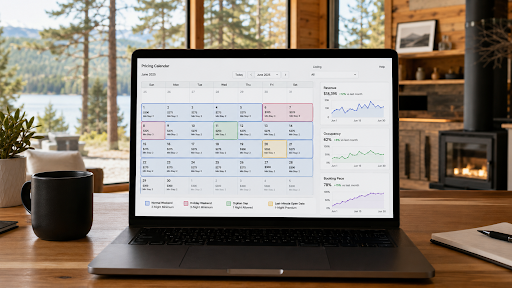
Start with the next 90 days. Mark the dates that already have real demand behind them: peak weekends, holidays, local events, school breaks, seasonal spikes, and weekends where nearby comps are pacing well. These are the dates worth a tighter rule.
Separate the weak dates from the strong ones. A normal Tuesday in January does not need a 4-night minimum. A Fourth of July weekend in a lake market probably does. Normal weekends might stay at 2 nights. Stronger weekends and event dates may merit 3 or 4 night minimums.
Orphan gaps need their own logic. If one guest checks out Wednesday and the next checks in Sunday, you have 3 open nights. A 4-night minimum guarantees those nights stay empty because nobody can book the full gap. Drop that specific gap to a 1-night minimum and take the booking.
Last-minute dates work the same way. If a date is still empty inside 5 days, loosen the minimum and let it fill. A single-night stay at a reasonable nightly rate still covers the turn and puts money on the calendar that wasn't there before.
The goal isn't to avoid short stays. It's to stop giving away your strongest dates to them.
Visibility Will Not Fix A Bad Rule
The same data found that Airbnb search-to-booking conversion stayed between 1.2% and 2.4% over the past year. Listings were appearing on the first page of search results between 41% and 45% of the time. The exposure is there. The conversions are not.
Getting found is not the bottleneck. Before a guest commits, they are filtering through price, fees, photos, reviews, cancellation terms, and stay rules. A listing that shows up in search but requires a 7-night minimum in a market where most guests book 2 to 3 nights is not going to convert. Visibility got them there. The calendar rule sent them away.
One more number worth factoring in: Vrbo search demand for March 2026 was up 74% year-over-year. July dropped 45%. August fell 58%. The demand signal is not evenly spread across the season. Spring interest is up, late-summer interest is down, and last year's pacing may be a bad guide for this year's pricing.
Minimum-stay settings are part of that filter. Loose rules give away strong dates to shorter stays. Strict rules block guests who were ready to pay.
Still Have Questions?
Minimum-stay rules are easy to understand in theory. They get harder when you're staring at your own calendar and trying to decide what to change. Inside the Host Camp community, you can ask experienced hosts how they would think through the same problem. Bring your calendar question, your orphan gap, or the rule you're unsure about.
