

Airbnb vs. Vrbo vs. Booking.com: Who Pays Hosts More
Written by: Kai Andrew
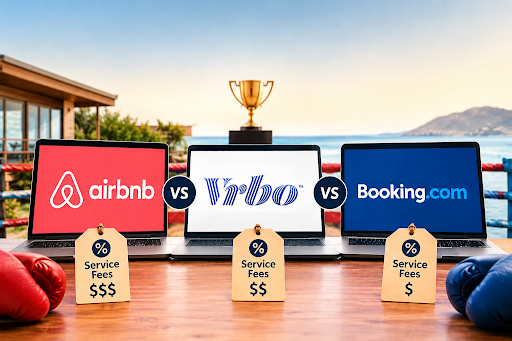
We ran the real math on fees, reach, guest quality, and protection across all 3 platforms. These are the real figures each one charges today, not the advertised rates.
What Each Platform Charges You

Airbnb now charges most hosts 15.5% of the booking subtotal, taken entirely from your payout. That became standard for any host connected through property management or channel-management software back in April 2026.
If you're an independent host without that kind of software, you might still be on the older 3% split-fee model. Under that model, the host paid 3%, and the guest paid a separate service fee on top. That option is going away everywhere outside the EU on September 15, 2026, and in the EU on October 13, 2026. After that, every Airbnb host pays 15.5%.
Vrbo costs nothing to list on, then charges a flat 8% per booking, 5% commission plus 3% payment processing.
Booking.com never publishes a rate at all. Their own help page states commission varies by country and can also vary depending on property type or location, and the only place to find your real number is your contract or your Extranet account. A typical baseline runs 10% to 25%, averaging around 15%, higher if you're in their Preferred Partner visibility program.
Here's what that looks like on a $300-a-night, 3-night booking, $900 total: Airbnb's standard 15.5% fee nets you $760.50. Vrbo nets you $828. Booking.com's typical rate nets you around $765. If you're one of the shrinking number of hosts still on Airbnb's legacy split-fee, you'd net $873, but that option disappears for good by mid-October.
Once it's gone, Airbnb becomes the platform netting hosts the least on this example. That's a reversal from Airbnb's old reputation as the affordable option and Booking.com's reputation for hiding its rate. For everything else a listing costs beyond platform fees, see our breakdown of the real costs of running an Airbnb.
How Big Each Platform Is

Airbnb publishes its numbers clearly: 9M+ active listings, 5.5M+ hosts, 220+ countries and regions, $300B+ earned by hosts all-time.
Booking.com is bigger overall (roughly 30M+ total listings), but its homes-and-apartments category specifically sits at 8.8M, close to Airbnb's total scale, buried inside a platform known mainly for hotels.
Vrbo doesn't publish a current listing count anywhere official. That's a second transparency gap, this time about the platform's size.
Who Each Platform Sends You

Airbnb guests skew younger (median age 25 to 44) and book shorter stays, 2 to 3 nights on average. Hosts consistently flag one downside in community discussions: Airbnb support tends to side with the guest when a dispute goes to a claim. If that ever happens to you, here's what to do about an unfair Airbnb review.
Vrbo guests skew toward families and larger groups, with stays running 4 to 7 nights. Hosts describe this guest base as older and lower-risk for property damage, and Vrbo reaches travelers who never open the Airbnb app at all.
Booking.com pulls a more international crowd, including people living abroad booking a US stay. Hosts describe these guests as more transactional and more price-sensitive, with more competition on price than the other 2 platforms.
Protection follows the same pattern as everything else here: Airbnb covers the most automatically, $3M in damage protection plus $1M in liability. Booking.com covers a solid middle ground, $1M in liability everywhere, plus $1M in damage protection if your property is in the US, Puerto Rico, or the US Virgin Islands. Vrbo puts the damage protection decision back on the host, the $1M liability piece is the only part that's automatic.
Where to List First

No platform publishes real data on how fast a new listing gets its first booking, so we're not going to hand you a fake number.
What we found instead was a consistent pattern in how hosts sequence their listings. List on Airbnb first, since it's the easiest platform for early traction and your first reviews (see our guide to building a listing that gets booked). Add Vrbo once you have some track record, then Booking.com once you're established. If you're managing more than one platform at once, this property management tool keeps your calendars synced at no cost. That's a pattern from hosts who've done it this way, worth more than a stat nobody's published.
List Airbnb First, Then Vrbo, Then Booking.com

List on Airbnb first, but watch which fee model you land in. Add Vrbo once you're established, for the lower-risk, longer-staying guest base. Add Booking.com last, once you can absorb a rate you won't know until you've already signed the contract.
Skipping straight to all 3 at once, or picking just 1 forever, is the mistake to avoid here. Run this sequence against your own property before you decide where it lists first.


